ACML 2026 Workshop onReusable Models for Continual and Adaptive Learningin the Foundation Model Era |
||
Melbourne, Australia
|
||
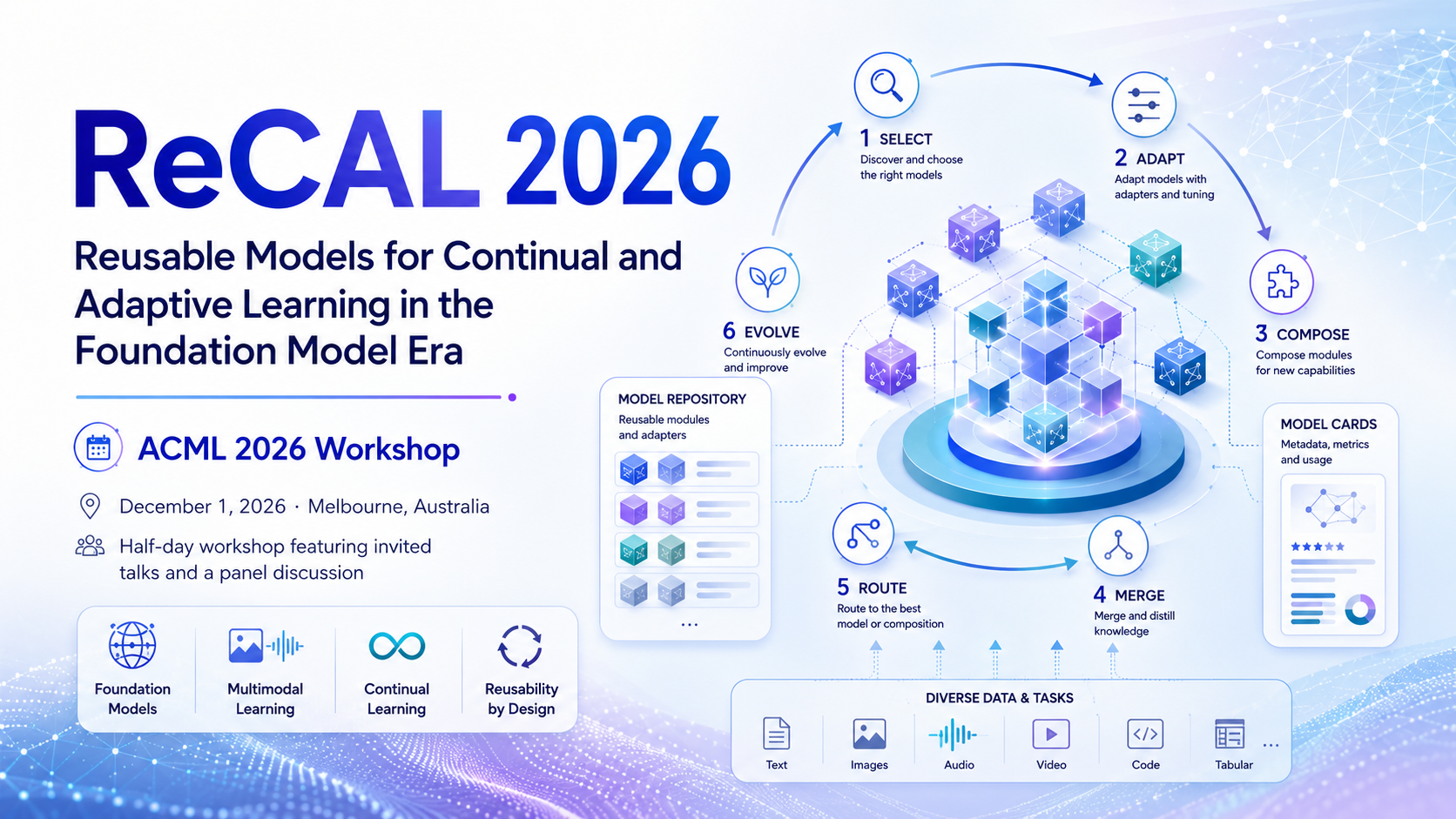
ACML 2026 Workshop onReusable Models for Continual and Adaptive Learningin the Foundation Model Era |
||
Melbourne, Australia
|
||
The rapid growth of pre-trained models and foundation models has transformed machine learning from a purely data-centric practice into a model-centric ecosystem, where existing models, modules, adapters, and model zoos can be selected, adapted, composed, and maintained over time. This workshop positions model reuse as a unifying paradigm for building AI systems that can learn, update, and specialize continually under evolving tasks, domains, modalities, and user requirements.
Rather than treating continual learning and model reuse as two parallel topics, ReCAL 2026 focuses on how reusable model resources enable continual and adaptive learning, and how continual adaptation in turn reshapes the construction, evaluation, and management of reusable model repositories. The workshop will discuss techniques including pre-trained model selection, transferability estimation, parameter-efficient tuning, model merging, routing, retrieval augmentation, model editing, modular adaptation, and continual learning with foundation models. It will emphasize research insights, practical systems, benchmarks, and theoretical questions, with particular attention to advances from Asia and the broader Asia-Pacific community.
Machine learning has entered an era in which powerful pre-trained resources are widely available. Instead of training every model from scratch, practitioners increasingly reuse existing models through fine-tuning, distillation, parameter-efficient adaptation, prompt learning, model merging, routing, retrieval-based mechanisms, and modular composition. This shift is especially important for the ACML community because model reuse provides a practical route toward reducing data requirements, computational cost, carbon footprint, and deployment barriers, while still enabling strong performance in real-world applications.
A key challenge in this model-centric ecosystem is continual adaptation. Real-world AI systems are rarely deployed in static environments: new classes, tasks, domains, modalities, user preferences, and safety requirements arrive over time. Classical continual learning addresses this problem by studying how models can acquire new knowledge without catastrophic forgetting. In the foundation model era, however, continual learning is increasingly intertwined with model reuse. Pre-trained models can serve as stable knowledge sources, feature extractors, teachers, experts, adapters, or reusable components, while model repositories themselves must be continually evaluated, updated, specified, compressed, merged, and routed as new demands emerge.
Therefore, ReCAL 2026 adopts a hierarchical theme: reusable models as the core infrastructure, and continual/adaptive learning as a central objective and application scenario. On the classical side, the workshop will discuss model selection, transferability estimation, hypothesis transfer, knowledge distillation, model zoo management, learnware, and resource-constrained adaptation. On the modern side, it will focus on foundation models, LLM and VLM routing, modular deep learning, parameter-efficient tuning, retrieval-augmented generation, model editing, model merging, compression, and continual learning with pre-trained models. The invited program will connect theory and practice, including generalization analysis, negative transfer, forgetting metrics, memory-aware evaluation, and sustainable deployment.
ReCAL 2026 is timely for ACML because Asia has produced a fast-growing body of research on continual learning, transfer learning, foundation models, learnware, model zoos, model selection, and efficient adaptation. The workshop will provide an in-person venue in Melbourne for researchers from Asia, Oceania, and the international community to exchange ideas, form collaborations, and discuss how reusable model resources can support AI systems that remain adaptive over their lifetime.
ReCAL 2026 is planned as a half-day workshop at ACML 2026. Exact starting and ending times will be updated once ACML announces the official workshop timeslot.
| Duration | Session |
|---|---|
| 10 min | Opening Remarks and Workshop Overview |
| 40 min | Invited Talk 1 |
| 40 min | Invited Talk 2 |
| 30 min | Coffee Break and Informal Discussion |
| 40 min | Invited Talk 3 |
| 40 min | Panel Discussion |
| 10 min | Closing Remarks |
Topics include, but are not limited to:
ReCAL 2026 is a half-day, in-person workshop centered on invited talks and an interactive panel discussion. The workshop will not solicit contributed papers, extended abstracts, or posters; accordingly, there is no paper review process and no paper submission deadline.
Paper Submission Deadline: Not applicable (no contributed-paper submission). Researchers, students, and practitioners interested in continual learning, transfer learning, model reuse, foundation models, efficient machine learning, and modular AI systems are warmly welcome to attend and participate in the discussion.
For inquiries about the workshop, please contact zhoudw@lamda.nju.edu.cn.
The template is adapted from this page.