Sparse supervision for economical LLM routing
Routing should
pay for itself.
SAVERouter accounts for the feedback acquisition cost paid before deployment—and learns an effective router from only a sparse set of query-model outcomes.
Results from the paper's main setting across four evaluated benchmarks.
01 / The missing cost
A cheaper route can still be a bad investment.
Conventional evaluations emphasize serving-time quality and cost. But training a router first requires model executions on historical queries. SAVERouter puts that upfront supervision expenditure into the objective and the evaluation.
Before deployment
Acquire supervision
Upfront expenditure C0
After deployment
Save per request
Baseline Cb − routed Cr
The real question
When does it pay back?
Measured by SA-BEP and SA-CR
02 / Method
Spend feedback where it teaches the router most.
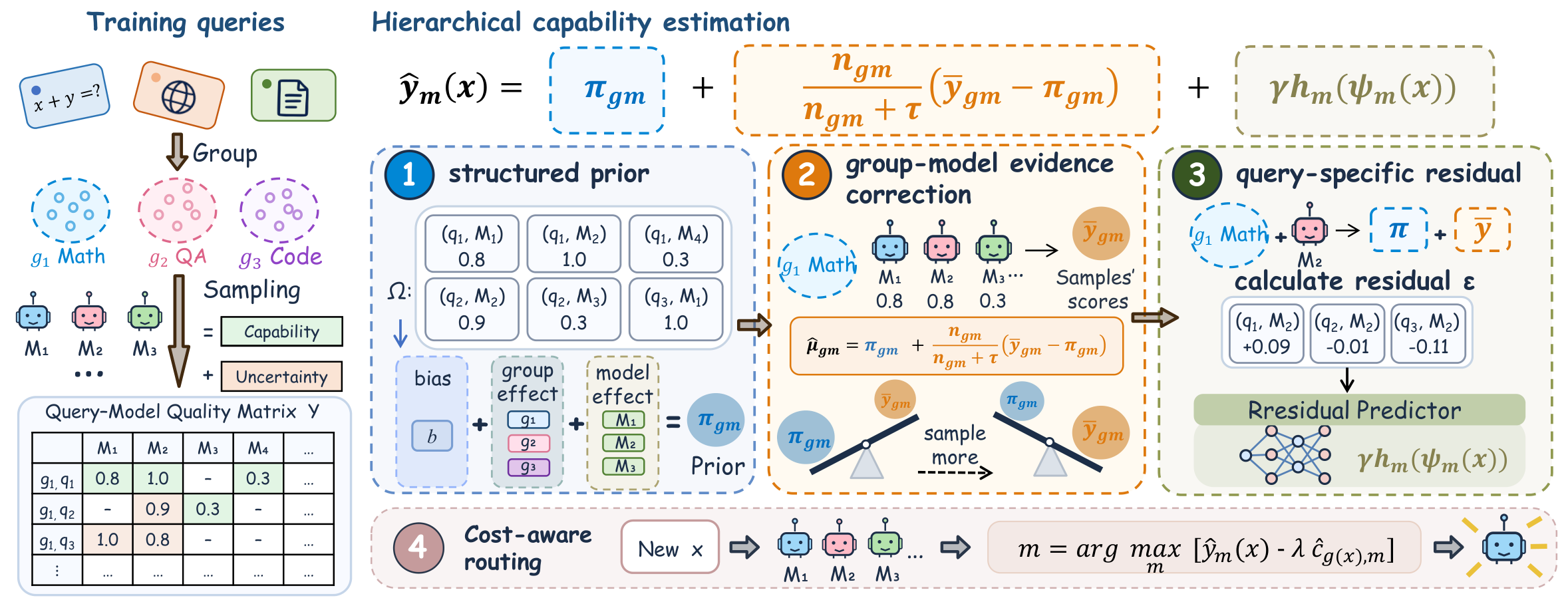
SAVERouter adaptively selects exactly K model outcomes per training query, shares capability evidence across related queries, then learns query-level residual corrections for fine-grained routing.
Adaptive acquisition
Grouped empirical-Bayes UCB chooses informative model outcomes under a fixed feedback budget.
Capability sharing
A structured group-model prior pools evidence across related queries without requiring dense labels.
Local refinement
Contextual residuals retain query-specific variation and construct a quality-cost routing frontier.
03 / Evidence
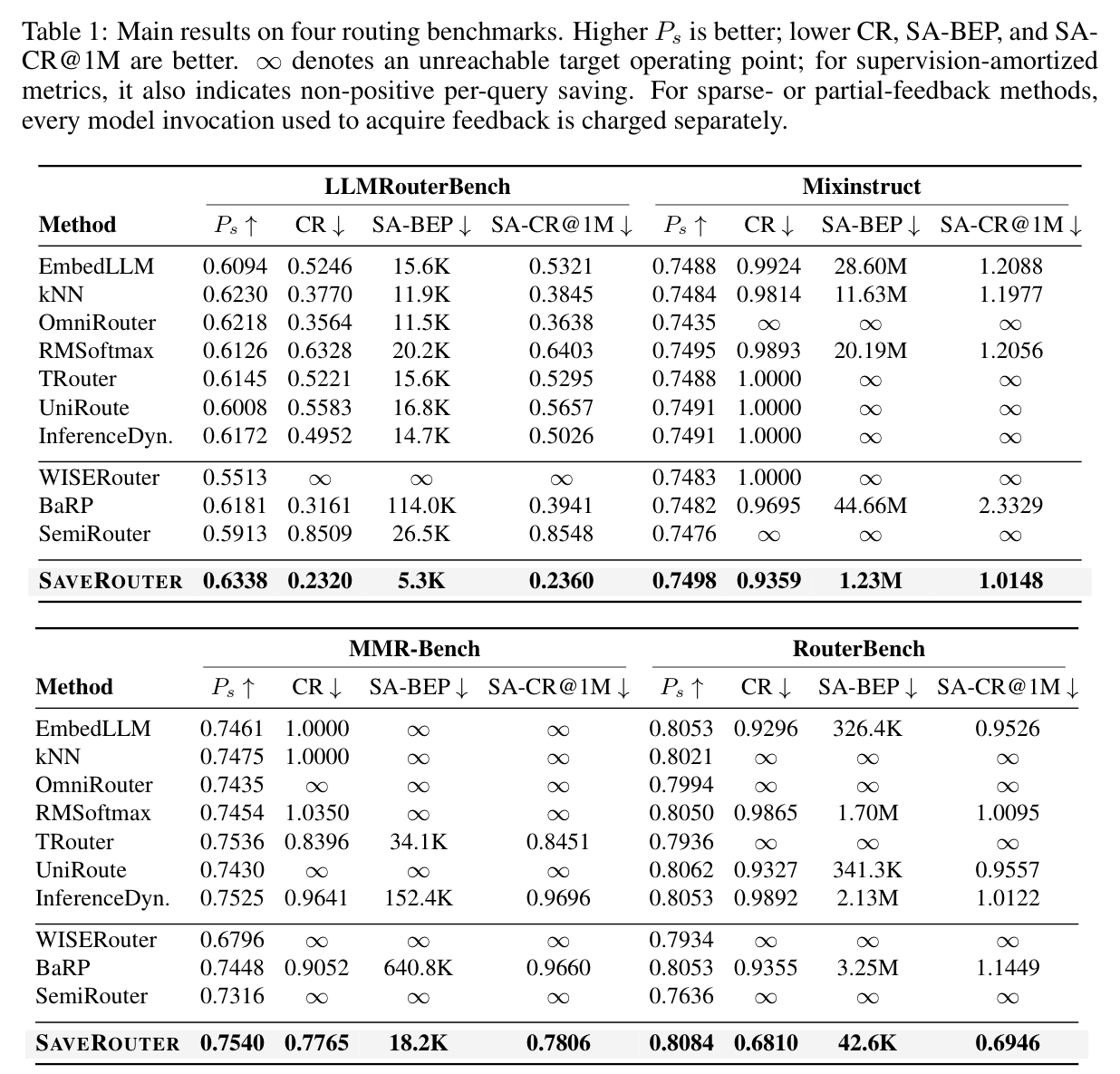
Earlier payback without sacrificing routing quality.
The paper evaluates SAVERouter on LLMRouterBench, Mixinstruct, MMR-Bench, and RouterBench. Lower CR, SA-BEP, and SA-CR are better; higher peak score is better.
04 / Payback Explorer
Estimate when your router pays back.
Enter costs in any consistent unit. The calculator visualizes supervision-amortized break-even and total cost over deployment traffic.
Best single modelRouter + supervision
05 / Try and reproduce
From thirty seconds to the full benchmark suite.
Choose the path that matches your goal. The smoke test and tutorial require no benchmark downloads; the paper suite uses frozen profiles and pinned data revisions.
Smoke test
python -m pip install saverouter
saverouter smoke-testCPU Colab
Generate a small structured routing problem, acquire sparse feedback, fit SAVERouter, and inspect payback metrics.
Open notebook ↗Full reproduction
bash scripts/reproduce.sh allApproximately 12–15 GB of free disk space; CUDA is recommended for MMR-Bench and first-time feature extraction.
Reproduction guide →Citation
Build routing systems that account for the bill before deployment.
@article{lai2026routing,
  title   = {Routing Should Pay for Itself: Sparse Supervision for Economical LLM Routing},
  author  = {Lai, Guannan and Bian, Gelin and Ma, Hao-Xuan and Jiang, Jun-Peng and Chen, Long and Liu, Jian-Dong and Tan, Zhi-Hao and Ye, Han-Jia},
  journal = {arXiv preprint arXiv:2609.37402},
  year    = {2026}
}