Observe
Collect a small context of queries, outcome quality, and relative cost for every candidate.
RouteFM learns a reusable routing capability across heterogeneous environments, then adapts to unseen tasks and candidate pools from a few behavioral observations—without retraining.
Conventional routers are fitted to one workload and one fixed candidate pool. When the environment changes, routing starts over.
RouteFM turns model routing into an in-context adaptation problem. It characterizes anonymous candidates using observed query, quality, and relative-cost tuples, and transfers one frozen router across domains, modalities, candidate pools, and context budgets.
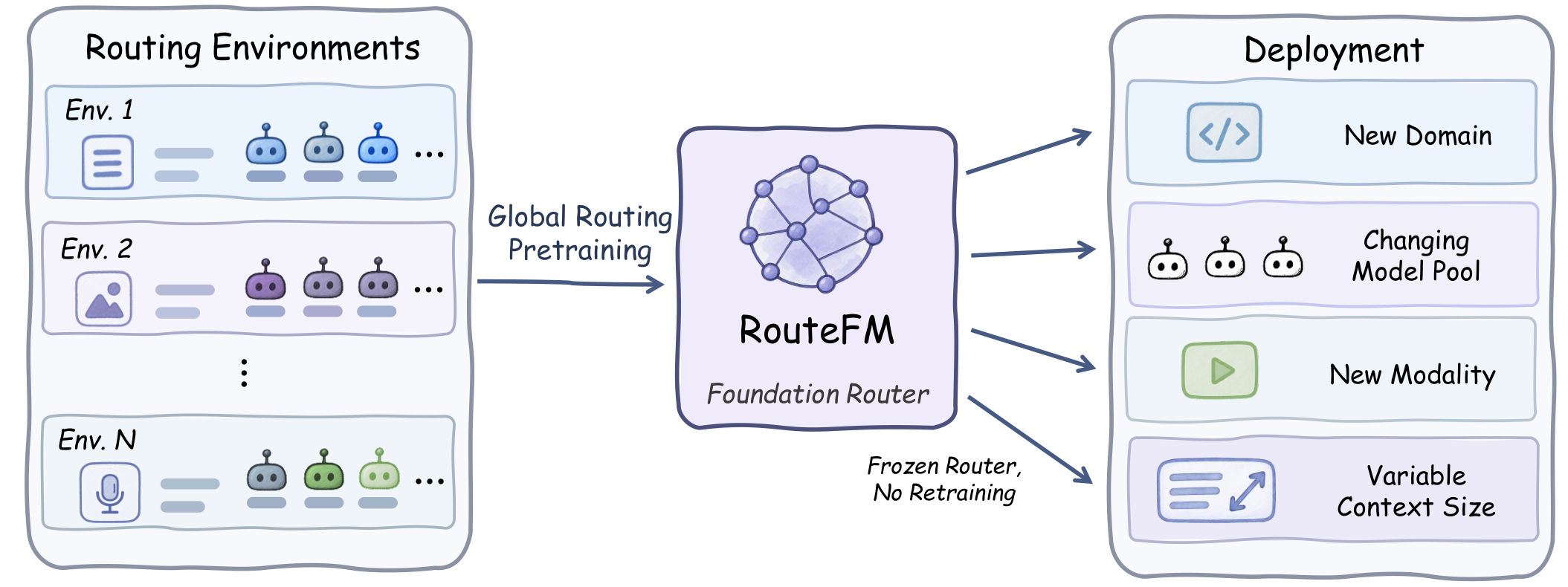
Candidate names label the output; they are never used as model features. RouteFM reasons from evidence instead.
Collect a small context of queries, outcome quality, and relative cost for every candidate.
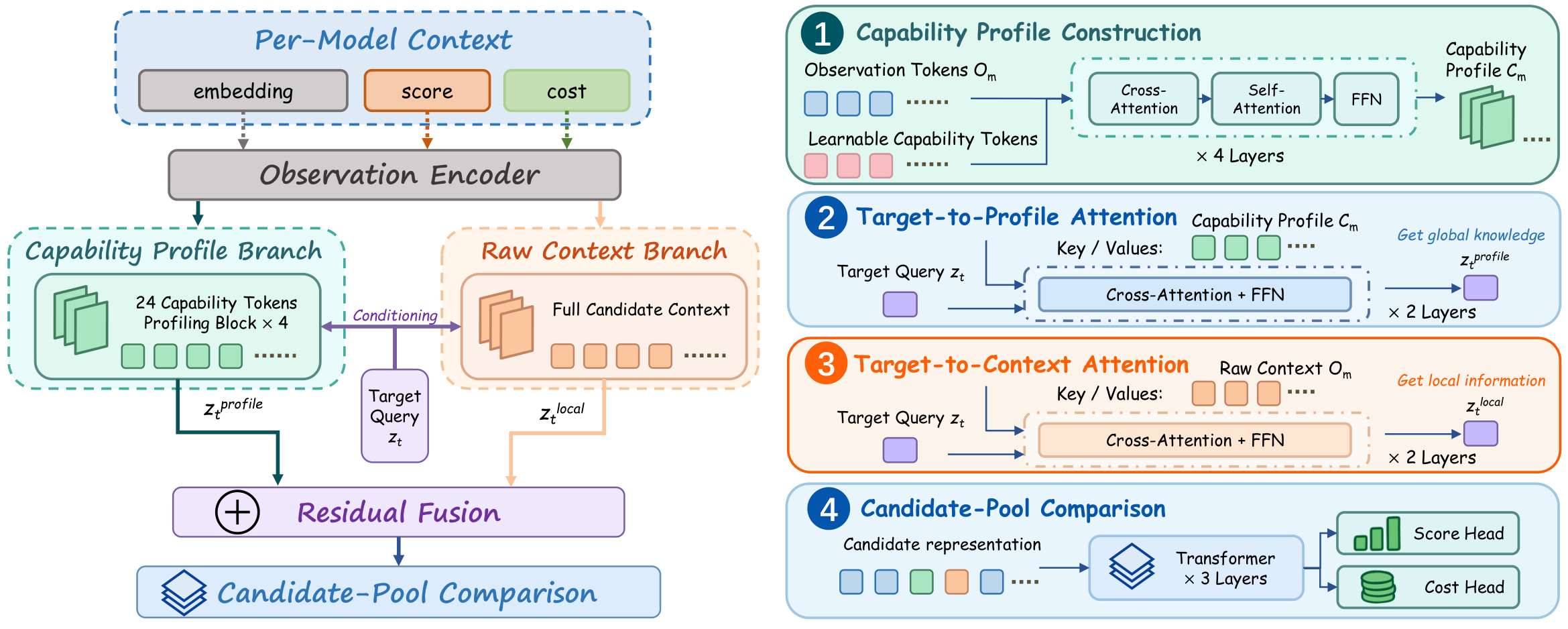
Compress behavioral evidence into capability profiles while retaining fine-grained context.
Jointly compare the current candidate pool with a permutation-equivariant Transformer.
Predict target-specific quality and cost, then select the candidate for the new query.
On MMR-Bench, excluded entirely from pretraining, RouteFM transfers across modality, task, and candidate-pool shifts.
Results use the paper's dataset-wise five-fold evaluation protocol. Please consult the paper for baselines, uncertainty, and complete experimental settings.
Choose an environment, target query, and observation budget. The candidates remain anonymous—their behavior is all RouteFM sees.
The free embedded demo switches among predictions precomputed with the released frozen RouteFM-BGE checkpoint. Its synthetic contexts are illustrative—not benchmark records or live provider outputs. The repository also includes a full Gradio app for arbitrary queries.
Install the published Python package. The first run downloads the immutable RouteFM-BGE checkpoint and its frozen query encoder.
$ pip install "routefm-router[bge]"

from routefm import RouteFMRouter

router = RouteFMRouter.from_pretrained(
    encoder="bge", device="cpu"
)
router.set_context(candidates)

decision = router.route(
    "Prove there are infinitely many primes."
)
print(decision.model_name)If RouteFM supports your research, please cite our paper.
@misc{lai2026pretrainoncerouteanywhere,
  title  = {Pretrain Once, Route Anywhere: Towards a
            Foundation Model for LLM Routing},
  author = {Guannan Lai and Han-Jia Ye},
  year   = {2026},
  eprint = {2609.37362},
  archivePrefix = {arXiv},
  primaryClass  = {cs.AI}
}